Mauritius is a volcanic island in the Indian Ocean, east of Madagascar and about 2,000 km off the south-east coast of Africa. It’s best known for its lagoons and white beaches, but there’s much more to it: forested mountains, a fascinating mix of cultures, and some of the best food in the region. This page gives you the essentials before you plan your trip.
Mauritius at a glance
| Capital | Port Louis |
| Size | The main island is about 65 km long and 45 km wide (around 1,865 km²). The whole republic, including Rodrigues and the outer islands, covers about 2,040 km². |
| Population | About 1.24 million (2022 census) |
| Languages | Mauritian Creole is spoken at home by nine out of ten people. English is the language of government and French is widely used in the media and business. Most Mauritians switch easily between all three. |
| Currency | Mauritian rupee (MUR, Rs) |
| Time zone | UTC+4, no daylight saving |
| Driving | On the left |
| Independence | 12 March 1968 (republic since 12 March 1992) |
A short history
Mauritius had no native population. Arab and Portuguese sailors knew of the island, but the Dutch were the first to try to settle it. They landed in 1598 and named it after Prince Maurice of Nassau, but abandoned the island in 1710. It was during this period that the dodo, found only on Mauritius, was hunted and driven to extinction.
The French took over in 1715 and called it Isle de France. They built Port Louis and developed sugar plantations worked by enslaved people brought mainly from Madagascar and mainland Africa. The British captured the island in 1810. Slavery was abolished in 1835, and over the following decades hundreds of thousands of indentured labourers arrived, most of them from India, to work on the sugar estates. Mauritius became independent in 1968.
Two UNESCO World Heritage Sites tell this story: Aapravasi Ghat in Port Louis, the immigration depot where indentured labourers arrived, and Le Morne Cultural Landscape, the mountain where escaped enslaved people sought refuge.
People, languages and religion
Today’s Mauritians descend from Indian, African, Malagasy, Chinese and European ancestors, and that mix shapes everything from the food to the calendar of public holidays. According to the 2022 census, just under half the population is Hindu, about a third Christian (mostly Catholic) and around 18% Muslim, with smaller Buddhist and other communities.
In everyday life you’ll hear Creole almost everywhere. Signs, menus and official documents are usually in English or French, and staff in hotels and restaurants generally speak both, so getting by is easy.
Festivals
Many religious festivals are public holidays and are well worth seeing:
- Thaipoosam Cavadee (January or February): a Tamil festival with processions of devotees carrying decorated cavadees.
- Chinese Spring Festival (January or February): lion dances and firecrackers, especially in Port Louis Chinatown.
- Maha Shivaratri (February or March): hundreds of thousands of Hindu pilgrims walk to the sacred lake of Grand Bassin.
- Divali (October or November): the festival of lights, when homes are decorated with oil lamps and fairy lights.
- Eid al-Fitr: the end of Ramadan, with the date moving each year.
- Abolition of Slavery Day (1 February) and National Day (12 March).
Climate and when to go
Mauritius has a warm tropical climate with two seasons:
- Summer (November to April): hot and humid, with coastal temperatures usually around 25 to 31°C and the warmest sea of the year. It’s also the rainy season, and cyclones are possible, mainly between January and March.
- Winter (May to October): drier and cooler, with coastal temperatures typically around 18 to 25°C. The trade winds blow hard on the east and south coasts, while the west and north stay calmer and sunnier.
The central plateau around Curepipe is noticeably cooler and wetter than the coast all year round. For most visitors, May to June and September to December offer the best balance of sunshine, comfortable temperatures and lower rainfall. See our month-by-month weather guide for more detail.
Nature and wildlife
Mauritius lost much of its native forest to sugar cane and settlement, but what remains is protected and fascinating. Black River Gorges National Park, in the south-west, covers more than 6,500 hectares of forest, gorges and waterfalls and is the best place for hiking and birdwatching.
The island is also famous for conservation. In 1974 only four Mauritius kestrels were known to exist in the wild, making it one of the rarest birds in the world. The pink pigeon fell to around ten birds by 1990. Thanks to decades of work by the Mauritian Wildlife Foundation and the National Parks and Conservation Service, both species now number in the hundreds. You can see conservation in action on Île aux Aigrettes, a small nature reserve off the south-east coast with giant tortoises and rare endemic plants.
Under water, the island is ringed by a coral reef that encloses calm, shallow lagoons, ideal for snorkelling, especially in the protected Blue Bay Marine Park.
Things to do
- Beaches and lagoons: swim, snorkel or just relax at beaches such as Trou aux Biches, Belle Mare, Flic en Flac and Le Morne. See our guide to the best beaches in Mauritius.
- Boat trips: catamaran days to Île aux Cerfs in the east or the northern islets, and dolphin-watching trips off the west coast.
- Hiking: Le Pouce, Black River Peak and Le Morne Brabant all offer superb views. See mountains in Mauritius.
- The south-west: Chamarel’s Seven Coloured Earth, the Chamarel waterfall and the underwater waterfall illusion off Le Morne.
- Port Louis: the Central Market, Aapravasi Ghat, Chinatown and the Caudan Waterfront.
- Grand Bassin (Ganga Talao): a crater lake and the most important Hindu pilgrimage site on the island.
- Golf: Mauritius has a number of championship courses. See golf in Mauritius.
Food
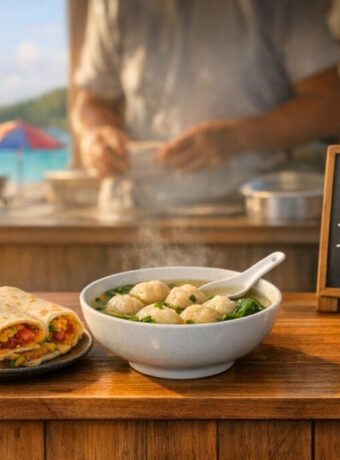
Mauritian food mixes Indian, Creole, Chinese and French influences, and it’s one of the highlights of a trip. Don’t miss dholl puri, thin flatbreads filled with ground split peas and served with curry and chutney, the island’s favourite street food. Other classics include gateaux piments (chilli fritters), boulettes (Chinese-style dumplings in broth), mine frite (fried noodles), fish or octopus vindaye and rougaille, a spicy tomato sauce served with fish, sausages or chicken. Street food is cheap, and eating where locals eat is one of the best ways to experience the island. Read more in our Mauritian food guide.
Getting around
- Car hire: the most flexible way to explore. Roads are generally good, but traffic around Port Louis can be heavy at rush hour. Remember that Mauritius drives on the left.
- Taxis and private drivers: easy to arrange through your hotel. Agree the price before you set off.
- Buses: cheap and cover most of the island, but they’re slow and services thin out in the evening.
- Metro Express: a modern light railway linking Port Louis with Rose-Hill, Quatre Bornes, Vacoas and Curepipe. It’s handy for the central towns but doesn’t reach the beaches.
See also our guides to car rental and airport transfers.
Practical tips
- Entry: citizens of the EU, the UK, the US and many other countries can visit visa-free for up to 90 days. Your passport should be valid for at least six months, and you may be asked for a return ticket and proof of accommodation. Every traveller must also fill in the free All-in-One Travel Form online before boarding, on the official Safe Mauritius portal. Rules change, so check the latest requirements before you travel.
- Money: cards are widely accepted in hotels, malls and larger restaurants, but carry rupees for markets, street food and small shops. ATMs are easy to find in towns.
- Sun: the UV index is very high all year, even on cloudy days. Use high-factor sun cream and reef-safe products if you can.
- Swimming: stay inside the lagoon, respect warning flags and don’t swim near passes in the reef, where currents can be strong. Wear water shoes to avoid sea urchins and stonefish.
- Temples and mosques: dress modestly, take off your shoes and ask before taking photos of people.